


Tests & Services
- DXA

DXA
Dual-energy X-ray Absorptiometry (DXA) is the gold standard for body composition assessment. The DXA scan uses a low-dose x-ray (less than 1% of a traditional chest x-ray) and provides information about total body bone mineral density (not-site specific), along with total and regional fat and lean mass as well as visceral fat within an accuracy of ± 2%.
A DXA scan costs $200. We do not accept insurance. We offer various discounts for military, first responders, students, etc. Payment will be made in person at the time of the visit.
- Eat and drink normally the day before the test.
- No heavy meals within 4-8 hours of testing
- Avoid smoking cigarettes, drinking coffee or alcohol 8 hours prior to the test.
- Avoid exercise at least 12 hours prior to the test.
- Wear athletic apparel or comfortable exercise clothing without metal components (e.g. buttons, zippers, etc...). You will also be asked to remove any eyeglasses, jewelry, or other accessories prior to the test. Lockers rooms are available if you need to change clothes.
- Stop taking calcium supplements 24 hours before your test. This includes multivitamins as well as antacids such as TUMS (commonly used to treat heartburn).
- All other medications or supplements are okay.
- If there are any questions about specific medications, please reach out to the testing team ([email protected] / 202-994-2654).
- Get an adequate amount of sleep (6-8 hours) the night before the test.
- This test is suitable/equipped for persons up to 450lb.
- Women on their menstrual cycle should wait until they are not menstruating, as changes in fluid levels during this time can affect DXA results.
- If you had any radionuclides (dyes, contrasts, etc via MRI or CT scan) within the last month, you are not eligible to undergo a DXA until they have cleared the system.
- If you think you may be pregnant or are breastfeeding, you may not participate in the DXA, due to low dose x-ray exposure.
- How long will the test take?
- You will lie still on your back on the DXA table for approximately 10 minutes as the scanner arm passes over your body. Our lab staff will then review the results with you and answer any questions you may have. Expect the entire session to take about 30 minutes.
- What should I wear?
- Wear athletic apparel or comfortable exercise clothing without metal components (e.g. buttons, zippers, etc...). You will also be asked to remove any eyeglasses, jewelry, or other accessories prior to the test. Lockers rooms are available if you need to change clothes.
- What should I do the day of testing?
- Participants should be as ‘inactive’ as possible prior to arriving to the laboratory. Light daily living activity is acceptable (dressing, driving, etc.).
- Void (use restroom) completely within 30 minutes of the test.
- Additional Considerations:
- This test is suitable/equipped for persons up to 450lb.
- Women on their menstrual cycle should wait until they are not menstruating, as changes in fluid levels during this time can affect DXA results.
- If you think you may be pregnant or are breastfeeding, you may not participate in the DXA, due to low dose x-ray exposure.
- If you had any radionuclides (dyes, contrasts, etc via MRI or CT scan) within the last month, you are not eligible to undergo a DXA until they have cleared the system.

- Resting Metabolic Rate
-
Resting Metabolic Rate
The resting metabolic rate (RMR) is the amount of energy (calories) a body burns while at rest, which accounts for approximately 70% of the body's daily energy expenditure. This is the amount of energy needed to perform vital body functions such as respiration and circulation. RMR can vary with age, sex, fitness level, and lean body mass. Using gas analysis, we can measure your RMR, which can be used to inform decisions regarding diet and exercise plans.
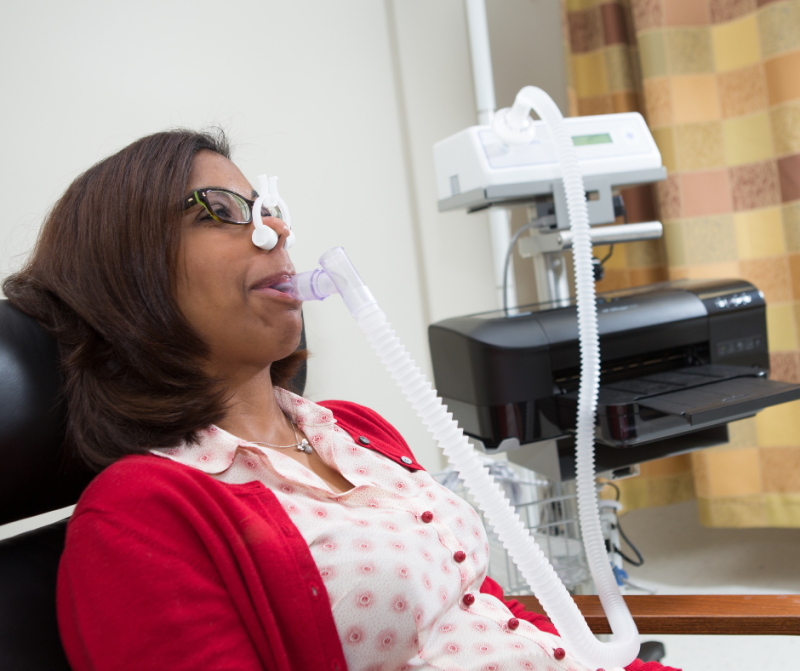
You will recline silently in a chair while breathing via your mouth only (nose will be closed) into a mouthpiece and tube for approximately 10-minutes. You cannot fall asleep during the test and should limit any fidgeting.
For the most optimal results, we recommend performing the RMR test in the morning after an overnight fast.
An RMR test costs $100. We do not accept insurance. We offer various discounts for military, first responders, students, etc. Payment will be made in person at the time of the visit.
- Eat and drink normally the day before the test.
- Fast for at least 8-12 hours prior to metabolism testing (water is fine).
- For the most optimal results, we recommend performing the RMR test in the morning after an overnight fast.
- Avoid caffeine, smoking cigarettes, drinking coffee, or alcohol 8 hours prior to the test.
- Avoid exercise at least 12 hours prior to the test.
- Refrain from taking any stimulant medications, including non-prescription medications like pre-workout, along with any energy drinks, nutritional supplements or medications containing ephedra, mahuang, or pseudoephedrine at least 12 hours before the test.
- All other medications or supplements are okay.
- If there are any questions about specific medications, please reach out to the testing team ([email protected] / 202-994-2654).
- Get an adequate amount of sleep (6-8 hours) the night before the test.
- How long will the test take?
- The test itself takes about 10 minutes. Our lab will then review the results with you and answer any questions you may have. Expect the entire session to take about 30 minutes.
- What should I wear?
- On the day of the test, individuals should wear comfortable, loose-fitting exercise clothing of their choosing.
- What should I do the day of testing?
- Participants should be as ‘inactive’ as possible prior to arriving to the laboratory. Light daily living activity is acceptable (dressing, driving, etc.).
- Only drink water the morning of testing.
- Void (use restroom) completely within 30 minutes of the test.
- Once you arrive, you will be able to sit comfortably while being tested. The technician will place a nose clip on your nose and you will be given a disposable mouthpiece to breathe through. This mouthpiece is connected to the machine by a hose that will measure how much air you are breathing out. It is very important that you breathe only through the mouthpiece so this measurement will be correct.
- Sit or recline comfortably and remain as still as possible. Do not fall asleep.
- Relax and breathe normally. Do not take exaggerated deep breaths or hold your breath, or take a lot of short and shallow breaths. Please also avoid talking, laughing, or unnecessary movement.
- Breathe quietly and naturally, as you would while resting on the couch.
- If you need to cough, swallow, or yawn, simply return to your normal breathing afterward.
- The key to an accurate RMR measurement is relaxation. The calmer and more comfortable you are, the more accurate your results will be.
- DXA + RMR Test Package
-
DXA + RMR Package
It is very common to get your body composition and resting metabolic rate tested in the same session. The combination of these assessments will give you a full picture of energy expenditure & body composition. These can help guide you for proper caloric intake for weight loss, maintenance or gain and give a point of reference for body composition.
For the most optimal results, we recommend performing the DXA+RMR test package in the morning after an overnight fast.
A DXA+RMR package costs $240. We do not accept insurance. We offer various discounts for military, first responders, students, etc. Payment will be made in person at the time of the visit.
- Eat and drink normally the day before the test.
- Fast for at least 8-12 hours prior to metabolism testing (water is fine).
- For the most optimal results, we recommend performing the RMR test in the morning after an overnight fast.
- Avoid caffeine, smoking cigarettes, drinking coffee, or alcohol 8 hours prior to the test.
- Avoid exercise at least 12 hours prior to the test.
- Wear athletic apparel or comfortable exercise clothing without metal components (e.g. buttons, zippers, etc...). You will also be asked to remove any eyeglasses, jewelry, or other accessories prior to the test.
- Stop taking calcium supplements 24 hours before your test. This includes multivitamins as well as antacids such as TUMS (commonly used to treat heartburn).
- Additionally, refrain from taking any stimulant medications, including non-prescription medications like pre-workout, along with any energy drinks, nutritional supplements or medications containing ephedra, mahuang, or pseudoephedrine at least 12 hours before the test.
- All other medications or supplements are okay.
- If there are any questions about specific medications, please reach out to the testing team ([email protected] / 202-994-2654).
- Get an adequate amount of sleep (6-8 hours) the night before the test.
- This test is suitable/equipped for persons up to 450lb.
- Women on their menstrual cycle should wait until they are not menstruating, as changes in fluid levels during this time can affect DXA results.
- If you had any radionuclides (dyes, contrasts, etc via MRI or CT scan) within the last month, you are not eligible to undergo a DXA until they have cleared the system.
- If you think you may be pregnant or are breastfeeding, you may not participate in the DXA, due to low dose x-ray exposure.
- How long will the tests take?
- Both the DXA scan and the RMR test each take about 10 minutes. You will do the DXA first followed by the RMR. Our lab staff will then review the results with you and answer any questions you may have. Expect the entire session to take about 45-60 minutes.
- What should I wear?
- Wear athletic apparel or comfortable exercise clothing without metal components (e.g. buttons, zippers, etc...). You will also be asked to remove any eyeglasses, jewelry, or other accessories prior to the test.
- What should I do the day of testing?
- Please see the “Common RMR FAQs” and “ Common DXA FAQs” sections of those respective tests to learn more information about what to expect on the day of testing
- Additional Considerations:
- The DXA test is suitable/equipped for persons up to 450lb.
- Women on their menstrual cycle should wait until they are not menstruating, as changes in fluid levels during this time can affect DXA results.
- If you think you may be pregnant or are breastfeeding, you may not participate in the DXA, due to low dose x-ray exposure.
- If you had any radionuclides (dyes, contrasts, etc via MRI or CT scan) within the last month, you are not eligible to undergo a DXA until they have cleared the system.
- InBody BIA
-
InBody
The InBody Assessment is a non-invasive, quick, and accurate body composition analysis that provides a detailed breakdown of your muscle, fat, and water. This method uses bioelectrical impedance analysis, which sends a low-level, painless electrical current through the body. The resistance (or impedance) the current encounters as it travels through body tissues varies depending on the tissue type (water and muscle = low resistance, fat and bone = high resistance). By measuring this impedance, the device can estimate how much of your body is made up of water, fat, and lean mass.
The InBody report provides a breakdown of weight, total body water, lean mass, body fat mass, segmental lean and fat analysis, and visceral fat.
An InBody test costs $100. We do not accept insurance. We offer various discounts for military, first responders, students, etc. Payment will be made in person at the time of the visit.
- Maintain normal fluid intake and use the restroom before testing.
- Don’t wear heavy clothing, socks, jewelry, or lotion while testing. On the day of the test, individuals should wear comfortable, loose-fitting exercise clothing of their choosing. Lockers rooms are available if you need to change clothes.
- Abstain from prior eating (>3 hours).
- Abstain from exercise (>12 hours).
- Abstain from caffeine ingestion (>24 hours).
- Abstain from prior alcohol use (>24 hours).
- Get an adequate amount of sleep (6-8 hours) the night before the test.
- Women on their menstrual cycle should wait until they are not menstruating, as changes in fluid levels during this time can affect DXA results.
- If you are or think you may be pregnant or are breastfeeding, you may not participate in this test.
- If you have a pacemaker or defibrillator of any kind, you are not able to participate in this test, as the electrical current could interfere with the device.
- How long will the test take?
- The measurement itself only takes about 1-2 minutes, but the entire assessment takes about 5 minutes. Our lab will then review the results with you and answer any questions you may have. Expect the entire session to take about 20-30 minutes.
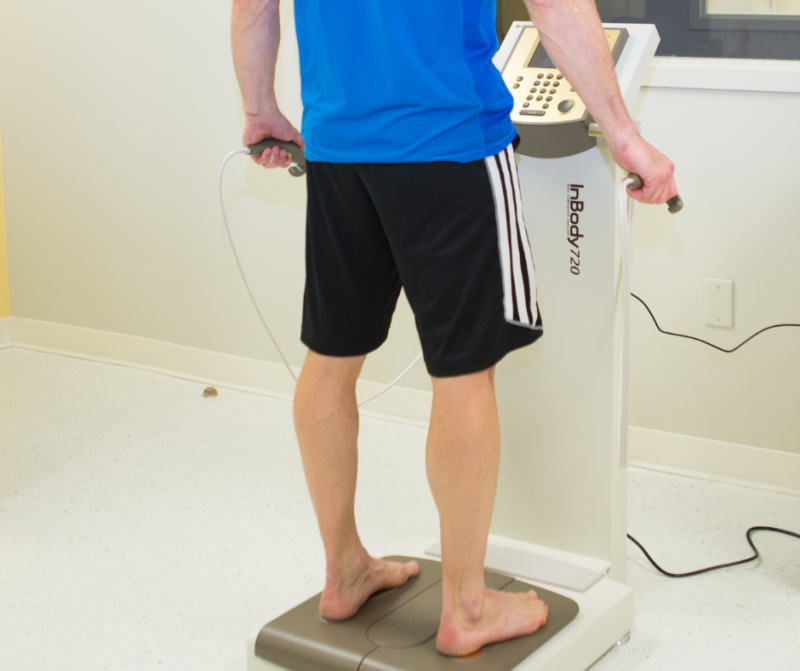
- During this relatively short duration test, a member of our lab staff will ask you to remove your shoes and socks, record your height and weight and instruct you to stand on the InBody machine with your bare feet on the conductive surfaces and hands gripping the handles. An undetectable electrical current is sent though your body via the four points of contact. You will not feel this. The test is over in approximately one to two minutes.
- What should I wear?
- On the day of the test, individuals should wear comfortable, loose-fitting exercise clothing of their choosing. Lockers rooms are available if you need to change clothes.
- *Please note, you will need to be barefoot for this assessment.*
- Additional Considerations:
- If you are or think you may be pregnant or are breastfeeding, you may not participate in this test.
- If you have a pacemaker or defibrillator of any kind, you are not able to participate in this test, as the electrical current could interfere with the device.
- VO2max Testing
-
Aerobic Fitness aka VO2Max Testing
VO2max, or maximal oxygen consumption, refers to the maximum amount of oxygen that an individual can utilize during intense or maximal exercise. VO2max measurement is generally considered the best indicator of cardiorespiratory fitness and aerobic endurance. It is considered to be the “gold-standard” for assessing cardiorespiratory fitness levels and allows for comparisons with normative values.
Low cardiorespiratory fitness levels are associated with marked increases in cardiovascular disease risk and all-cause mortality. A higher VO2max is strongly associated with better cardiovascular health, improved stamina, and a lower risk of chronic diseases like heart disease, stroke, and type 2 diabetes. Therefore, VO2max is closely related to the functional capacity of the heart and overall longevity.
The test is about 8-15 min total exercise time. The test is short but intense. The test starts at an easy-moderate intensity and gets progressively harder until exhaustion. For example, the speed and/or incline of the treadmill will increase every few minutes, or the resistance on the exercise bike will increase every few minutes.
The test is only performed on a treadmill or cycle ergometer (stationary bike).
A VO2max test costs $165. We do not accept insurance. We offer various discounts for military, first responders, students, etc. Payment will be made in person at the time of the visit.
- Please wear exercise clothing. That includes running shoes, cycling shoes, etc. We have locker rooms if you need to change.
- If you're a cyclist, you can bring in your own pedals and seat, as we can put them on our bike.
- Be sure to adequately hydrate the day before & day of the test.
- Be sure to properly fuel the night before & day of just as you would for a normal hard training session. Time your meals accordingly for the test. Bring water and a snack for after the test.
- Try to come in relatively fresh without any extra fatigue in your legs.
- Abstain from strenuous exercise at least 24 hours before.
- Do not warm up prior to the test. The test has a built in warm up period.
- Abstain from prior caffeine ingestion (> 12-24 hours).
- Abstain from prior nicotine use (> 3 hours).
- Abstain from prior alcohol use (> 24 hours).
- Get an adequate amount of sleep (6-8 hours) the night before the test.
- Participants should continue their medication regimen on their usual schedule so that exercise responses will be consistent with responses expected during exercise training.
- Why would I want to do a VO2max test?
- Standard fitness tests or even smartwatches rely on generic algorithms and estimates. By getting a lab-based VO2max test you can be sure you are receiving the most accurate assessment of your aerobic fitness. You will receive a classification of your aerobic fitness compared to normative values and a definition of your training zones based on heart rate and ventilatory responses to the exercise.
- VO2max is not just a performance metric! It is widely recognized as one of the strongest clinical predictors of long-term health and longevity. A higher maximal aerobic capacity is directly correlated with a significantly reduced risk of cardiovascular disease and all-cause mortality.
- You can also track your VO2max over time to assess the effectiveness of your training program and/or track your cardiorespiratory fitness over time.
- I’m not sure if I can handle a full VO2max test. Is a Submaximal VO2 test an option?
- Absolutely! If you are new to exercise, recovering from an injury, starting back again after a long layoff, or simply prefer to avoid extreme exertion, a submaximal VO2 test is a highly effective, scientifically validated alternative.
- Instead of pushing yourself to max, a submaximal test assesses your cardiovascular efficiency at moderate, controlled workloads. You will exercise on a treadmill or cycle ergometer at progressively increasing intensities while we monitor your heart rate and rating of perceived exertion.
- The test is terminated once your heart rate reaches a predetermined, safe threshold (typically 75% to 85% of your age-predicted maximum). Because there is a direct, linear relationship between your heart rate, workload, and oxygen consumption, we can use this submaximal data to accurately predict VO2max.
- If you are interested in doing a Submaximal VO2 test instead of a VO2max test, please reach out directly to [email protected] or 202-994-2654.
- Can I combine the Lactate Threshold test with a VO2max test?
- No. We prefer to do the tests separately for optimal results. However, we can bundle the pricing together for $275.
- What should I wear?
- Please wear exercise clothing. That includes running shoes, cycling shoes, etc. We have locker rooms if you need to change.
- Should I warm up on my own before coming in?
- No! You will have adequate time to warm up in the lab before the test. Warming up on your own beforehand can negatively impact the results.
- Will I have to wear anything during the test?
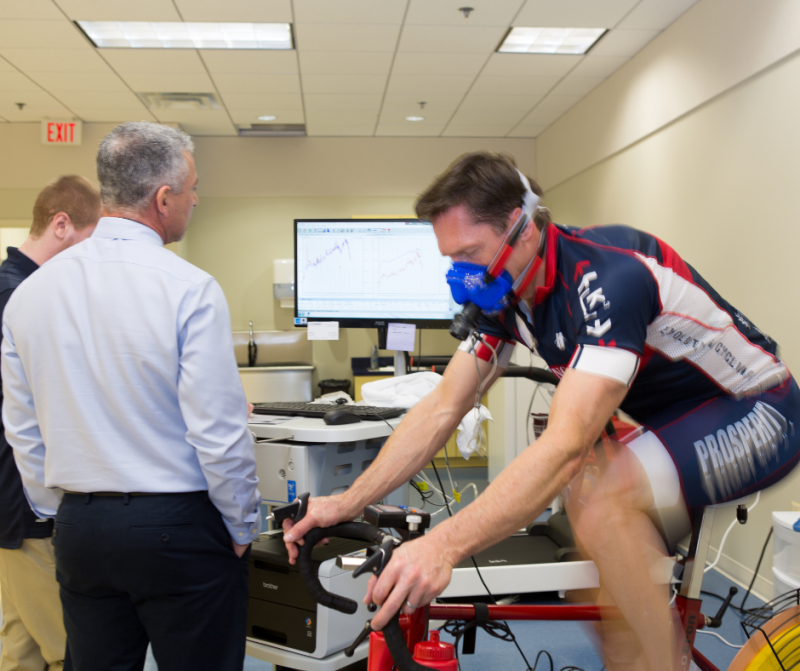
- Yes. Along with a chest-strap heart rate monitor, you will also wear a mask (as pictured above) that connects to a metabolic cart that monitors your gas exchange throughout the test.
- How long will the test take?
- The entire testing session will take about 1 hour. The actual test only takes about 8-15 minutes.
- When will I get my results?
- Our testing staff will go over the results with you after your test. You will receive a classification of your aerobic fitness compared to normative values and a definition of your training zones based on heart rate and ventilatory responses to the exercise.
- I’m a cyclist, can I bring my own bike?
- No, we have a bike that you will use for testing. It is highly customizable so you will be able to dial in your exact fit. However, you can bring your own pedals, as we can put them on our bike.
- Do I need to bring my own heart rate monitor?
- No, we have heart monitors you will use during testing.
- Is there a shower for after the test?
- Yes, we have locker rooms with showers on site. However, you must bring your own towel and toiletries, as we do not provide them.
Individuals with known cardiovascular health issues will not be allowed to participate in this test without the consent of a physician.
Please contact us directly to determine what test best suits your needs and to schedule. Call (202)994-2654 or email at [email protected].
- Lactate Threshold Testing

Lactate Threshold
The lactate threshold is the exercise intensity at which the body’s production of lactate is greater than the body’s ability to metabolize it. Crossing this threshold signals a shift from aerobic to anaerobic metabolism. If you’re an endurance athlete, knowing your lactate threshold is important for determining your optimal training intensities.
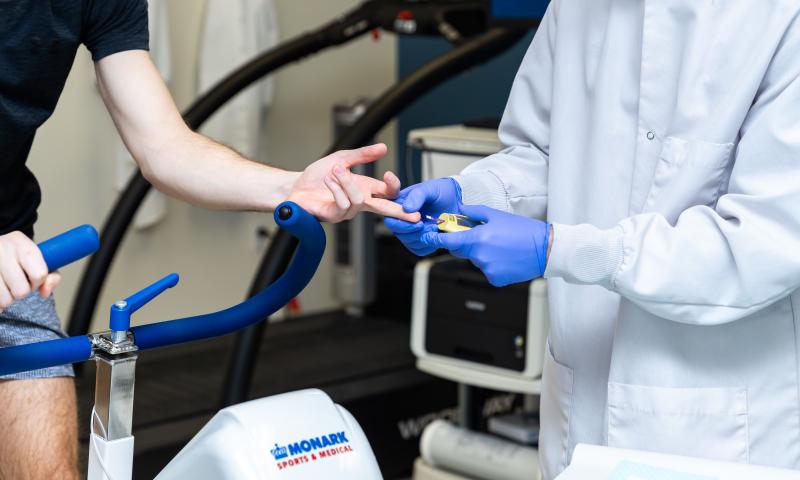
The test is comprised of several 5 minutes stages of increasing intensity (~10-20s per mile pace faster every stage for running or ~20W increases every stage for cycling). You will start at a moderate intensity and get progressively faster. If running, you will get a brief break (~30s) in between each stage when lactate will be assessed via finger prick. When cycling, the test is continuous. Not including a warmup, most people exercise for about 20-30 minutes (4-6 stages).
The test is only performed on a treadmill or cycle ergometer (stationary bike).
You will receive a personalized 5 zone training model with associated heart races and intensity zones (running paces or wattages).
A Lactate Threshold test costs $165. We do not accept insurance. We offer various discounts for military, first responders, students, etc. Payment will be made in person at the time of the visit.
- Please wear exercise clothing. That includes running shoes, cycling shoes, etc. We have locker rooms if you need to change.
- If you're a cyclist, you can bring in your own pedals and seat, as we can put them on our bike.
- Be sure to adequately hydrate the day before & day of the test.
- Be sure to properly fuel the night before & day of just as you would for a normal hard training session. Time your meals accordingly for the test. Bring water and a snack for after the test.
- Try to come in relatively fresh without any extra fatigue in your legs.
- Abstain from strenuous exercise at least 24 hours before.
- Do not warm up prior to the test. The test has a built in warm up period.
- Abstain from prior caffeine ingestion (> 12-24 hours).
- Abstain from prior nicotine use (> 3 hours).
- Abstain from prior alcohol use (> 24 hours).
- Get an adequate amount of sleep (6-8 hours) the night before the test.
- Participants should continue their medication regimen on their usual schedule so that exercise responses will be consistent with responses expected during exercise training.
- Why would I want to do a Lactate Threshold test?
- You’re an endurance athlete preparing for your next race looking for highly personalized heart-rate and exercise intensity thresholds based on your actual metabolic responses.
- Use subsequent testing to objectively track your physiological adaptations over time, verifying that your lactate curve is shifting and your training program is effectively increasing your endurance capacity.
- Determination of lactate threshold is often used as an acute marker of aerobic and anaerobic training adaptations. As you get fitter, your threshold moves. Retesting gives you hard data to assess if your training program is actually working.
- What should I wear?
- Please wear exercise clothing. That includes running shoes, cycling shoes, etc. We have locker rooms if you need to change.
- Should I warm up on my own before coming in?
- No! You will have adequate time to warm up in the lab before the test. Warming up on your own beforehand can negatively impact the results.
- How long will the test take?
- The entire testing session will take about 1 hour. Not including a warmup, most people exercise for about 20-30 minutes.
- Can I combine the Lactate Threshold test with a VO2max test?
- No. We prefer to do the tests separately for optimal results. However, we can bundle the pricing together for $275.
- When will I get my results?
- Within 24 hours you will receive an email of your report. You will receive a personalized 5 zone training model with associated heart races and either running paces or wattages.
- I tested on the treadmill. Can I apply the same results to my bike workouts?
- No. The test results are not transferable between modalities. If you tested on the treadmill, your results will only apply to running and vice versa for biking.
- I’m a cyclist, can I bring my own bike?
- No, we have a bike that you will use for testing. It is highly customizable so you will be able to dial in your exact fit. However, you can bring your pedals, as we can put them on our bike.
- Do I need to bring my own heart rate monitor?
- No, we have heart monitors you will use during testing.
- Is there a shower for after the test?
- Yes, we have locker rooms with showers on site. However, you must bring your own towel and toiletries, as we do not provide them.
Individuals with known cardiovascular health issues will not be allowed to participate in this test without the consent of a physician.
Please contact us directly to determine what test best suits your needs and to schedule. Call (202)994-2654 or email at [email protected]
Interested in a test bundle not listed here?
Please out to us at [email protected] / 202-994-2654.